
How Much Does a Bespoke Suit Cost in Dubai?
Most people who ask about bespoke suit cost in Dubai end up somewhere between AED 2,000 and AED 8,000. A true bespoke two-piece commonly starts around AED 2,000–4,000. Premium full-canvas work in better cloth tends to run AED 4,000–8,000. Luxury commissions can pass AED 8,000 and reach AED 15,000 or more.
Those numbers come with a warning. “Bespoke” doesn’t mean the same thing at every Dubai tailor. One shop uses it for a made-to-measure suit adjusted from an existing pattern. Another uses it for a garment drafted from scratch and fitted several times. The price gap between them is real, and often justified. The label alone won’t tell you which one you’re buying.
The ranges in this guide are budgeting ranges, not fixed Dubai-wide prices. Where a tailor publishes a “from” price, I’ve called it a starting price, because that’s what it is. Cloth, construction, options and fittings all move the final quote. The starting prices quoted below come from each business’s own published pages and will change over time.
Bespoke Suit Prices in Dubai at a Glance
|
Category |
Rough budgeting range |
What it usually means |
|
Off-the-rack |
AED 500–2,000 |
Finished garment in standard sizing. Alterations only. |
|
Entry-level custom / MTM |
AED 1,400–2,500 |
An existing pattern adjusted to your measurements. Standard cloth, fewer fitting stages. |
|
Mid-range MTM |
AED 2,000–4,000 |
Better fabric choices, more careful fit process, more styling options. |
|
Entry-level true bespoke |
AED 2,000–4,500 |
A tailor claims an individual pattern and multiple fittings. Verify before paying. |
|
Premium bespoke / full canvas |
AED 4,000–8,000 |
Better cloth, canvas construction, more handwork and fittings. |
|
Luxury bespoke |
AED 8,000–15,000+ |
Luxury cloth, extensive handwork, specialist cutting. Can go far higher for rare fibres. |
Published starting prices are where a conversation begins, not where it ends. A suit advertised “from AED 2,000” can land well above that once you pick a nicer cloth, add a waistcoat, or ask for a firmer deadline. The bands also overlap on purpose. A well-made MTM suit can cost more than a modest bespoke one, and neither fact is a contradiction.
First, What Does "Bespoke" Actually Mean?
Three categories cause most of the confusion.
Ready-to-wear is a finished suit in standard sizing. There’s no individual pattern. A tailor can shorten sleeves, take in the waist and hem the trousers, and that can make a big difference, but the garment was cut for nobody in particular.
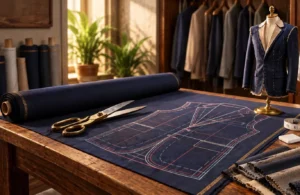
Made-to-measure (MTM) starts from an existing base pattern, often called a block, which is then adjusted to your measurements. You get a better fit than ready-to-wear, usually faster and for less money than full bespoke. Quality varies a lot, though. Some MTM is excellent. Some is a standard block with the sleeves let out.
True bespoke means a new pattern is drafted for you. The first fitting is usually a basted one, with the jacket held together by temporary stitching so the tailor can reshape it, and then further fittings follow. Industry references on the definitions describe genuine bespoke as normally involving at least two fittings, often three or more. The extra control matters most if you have sloping or uneven shoulders, a pronounced posture, or a build that standard blocks handle badly.
One point trips up many buyers: full canvas does not automatically mean bespoke. Canvas is how the jacket is built inside. Pattern-making is how it’s cut. A full-canvas jacket can be made-to-measure, and a suit sold as bespoke can vary in how much hand construction it includes. If you want the longer comparison, we’ve covered it in bespoke vs made-to-measure vs ready-to-wear suits in Dubai.
What Actually Makes a Bespoke Suit More Expensive?
Fabric
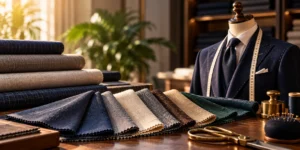
Cloth is often the most visible cost. One established Dubai tailoring house publishes a 100% wool two-piece from around AED 2,100 and a Super 130s wool two-piece from around AED 2,500, so even at a single tailor the specification moves the starting price. Some houses go further and price by mill: full-canvas suits in premium Italian cloth from around AED 5,500, cloth from a top-tier Italian mill from around AED 6,000, and the most luxurious cloth ranges from around AED 8,000.
A famous name on the swatch book is not a quality verdict on the finished suit, though. Italian and British labels tell you where the cloth came from. Fibre, weave, weight and finish tell you how it will behave, and how well it’s cut and sewn matters just as much. Some tailors note that very fine or rare fibres can push prices dramatically higher, and that’s a niche far removed from what most buyers need.
Dubai adds its own filter. You’re walking from a car park in serious heat into an air-conditioned office, or standing at an outdoor wedding in the evening. Heavy winter worsted is rarely the smart buy here, however prestigious it looks. Lighter, more breathable options such as tropical wool, linen or wool-silk-linen blends tend to make more sense, depending on when and where you’ll wear the suit. We’ve written a separate guide to suit fabrics for Dubai weather that goes into it properly.
Construction
Construction is the internal structure of the jacket.
- Fused: the interlining is bonded to the cloth with adhesive. It’s generally the lowest-cost route, and can be perfectly reasonable for occasional wear or a tight budget.
- Half canvas: a canvas layer supports the chest and lapel area. It often sits as a middle ground between cost and structure.
- Full canvas: the canvas runs through the whole front of the jacket. It usually costs more because it takes more material and more skilled labour.
One Dubai tailoring house offers a useful local data point: half-canvas from AED 3,950 and full-canvas from AED 4,450. That gives you a feel for the premium before any luxury cloth enters the picture.
Full canvas isn’t automatically better for every person or every use. A suit you’ll wear twice a year may not need it. Our full canvas vs half canvas comparison goes into when it earns its extra cost.
Pattern Cutting and Fittings
Drafting a fresh pattern takes a cutter’s time and judgment, and every additional fitting takes workshop time, calendar time and skill. This is a big part of why true bespoke costs more than MTM. You’re paying for a garment shaped around you rather than adjusted toward you.
It’s also the area where you should ask questions, because the words “individual pattern” and “multiple fittings” are easy to print on a website. More on that in the checklist below.
Handwork and Finishing
Hand-padded lapels, hand-sewn buttonholes, hand-set sleeves and hand-finished edges all take labour, and labour costs money. Real handwork can add refinement.
But not every hand-finished detail improves every suit. A hand-sewn buttonhole on a jacket that fits badly is a wasted expense. Ask which details are actually done by hand and decide whether you care about them. Some buyers do, and some would rather spend the money on better cloth or an extra fitting.
Two-Piece, Three-Piece and Tuxedo
More garment, more cloth, more labour. The published examples give a sense of scale. One Dubai tailor lists a bespoke two-piece from AED 2,000 and a three-piece from AED 2,800. Another lists AED 3,000 for a two-piece and AED 3,500 for a three-piece. Both show a waistcoat adding a few hundred dirhams at the starting-price level. Your own quote will depend on cloth and specification.
A tuxedo can cost more than a standard business suit because of satin facings, silk-covered details and the finishing they need. The added cost varies by tailor, so ask for a written quote rather than assuming.
Tailor, Location and Service
A prime business-district address, a private appointment model or a well-known cutter can all raise the price. So can home visits: one Dubai tailor, for example, lists a home-service charge of AED 250. Where the pattern-making and production actually happen matters too, since some houses cut on site and others outsource.
None of this means an expensive neighbourhood automatically produces better tailoring. Rent and service model shape the price. Whether the jacket fits and the construction holds up shapes the quality. The two overlap sometimes, but they aren’t the same thing. If you want help judging that difference, see how to spot a good tailor.
Rush Orders and Alterations
Urgent commissions can cost extra, or force a tailor to cut down on fittings, which defeats some of the point of going bespoke. Additional alterations after delivery, special sizing needs and design changes may also affect the final figure. Larger sizes can attract a surcharge at some houses. Some Dubai tailors mention this explicitly on their pages.
What Can You Get at Different Budgets?
Under AED 2,500
This is mostly entry-level custom and MTM territory, with a few bespoke-labelled starting prices sitting at the top of it. Established Dubai tailoring houses may list standard two-piece suits from around AED 1,450, and some advertise a made-to-measure business suit at around AED 2,099 that includes Super 130s wool and home fittings. Some Dubai tailoring houses publish bespoke two-piece suits from around AED 2,000.
That doesn’t make everything here poor quality. A clean MTM suit in sensible wool can serve a working wardrobe well. What you should expect is a narrower choice of cloth, fewer fitting stages and less structural work. Also expect to read the small print more carefully: a starting price at this level can rise quickly once options are added.
AED 2,500–4,500
This is where the comparison gets interesting, and where you’ll need to look closely at what each quote actually includes. You’ll find better cloth choices, more careful fit processes, and tailors who describe their work as bespoke. A published bespoke two-piece at AED 3,000 falls in here, and so does a true bespoke two-piece from AED 3,950 at another Dubai house.
Industry directories give a broad orientation for Dubai, with listed starting prices generally running from about AED 2,800 to AED 5,000 and up, depending on the house, cloth and handwork. Treat that as a signpost. It doesn’t replace reading a specific quote.
AED 4,500–8,000
Here premium options appear. Full-canvas construction becomes standard rather than special (one Dubai house’s full canvas starts at AED 4,450), and named Italian cloth enters the conversation. Published examples of premium-cloth full-canvas suits start around AED 5,500, and cloth from a top-tier Italian mill starts from around AED 6,000.
You’re paying for better materials, more handwork, more fittings and often a more polished service. Still, “premium” is a description, not a guarantee. Compare the specifics: which cloth, which construction, how many fittings.
AED 8,000+
This is the luxury segment. Cloth, handwork, service model, provenance and complex individual requirements can all move the quote significantly. Suits in the most luxurious cloth ranges start at around AED 8,000 in published examples, and one premium travelling UK house lists made-to-measure two-piece suits from AED 10,000. That number reflects its positioning, not a Dubai market average.
Spending more doesn’t automatically buy a better-fitting or better-looking suit. It buys different inputs. Some buyers value those inputs enormously. Others would be just as happy at a lower tier.
How Much Should You Budget for Different Occasions?
I can’t give exact prices for every occasion without inventing them, so here is what pushes the figure up or down.
Business suit. This is the simplest case. A two-piece in a sensible wool, with a construction level matched to how often you’ll wear it, sits at the lower end of whatever tier you choose. If you’re wearing it three or four days a week, put more into fit and cloth durability than into decoration.
Wedding suit. The budget depends heavily on timing and complexity. A wedding often means a three-piece, a more distinctive cloth, and a firm deadline that limits your options. Build in fitting time and don’t let a tight date push you into cutting fittings. Our comparison of a wedding suit versus a business suit covers the differences in more detail.
Three-piece suit. Expect a step up from the two-piece price, as the examples above show. The exact difference varies by tailor and by cloth.
Tuxedo or black-tie suit. Satin details and specialist finishing can add to the price. Ask whether the quote covers the full formal specification or a standard suit with tuxedo styling.
Premium everyday wardrobe. If you’re building several suits over time, the smart question is whether to spend more per suit or buy more suits at a lower tier. There’s no single right answer. A repeat client may benefit from a tailor who keeps a pattern on file and refines it across orders.
How Long Does a Bespoke Suit Take in Dubai?
The sequence goes: consultation, measurements, pattern, fitting, alterations, final fitting. Each stage takes calendar time, not just workshop time, because you have to come back and try things on.
Industry directories for Dubai show lead times commonly running from about two to six weeks, with a lot of variation. Some houses are listed at 10 days to four weeks, and others at six weeks. For weddings, industry guides suggest starting three to four months ahead so fittings don’t happen under pressure. Some Dubai tailors offer faster services, but a faster timeline may mean fewer fittings or a rush charge.
No universal turnaround exists. Ask for the specific timeline for your order, in writing.
7 Questions to Ask Before Paying for a Bespoke Suit
Get the answers before you hand over a deposit. Clear answers make it easier to compare one tailor’s quote with another.
- Is this true bespoke or made-to-measure? Ask plainly. A straight answer beats a vague one.
- Will a new individual pattern be drafted for me? Or is an existing block being adjusted?
- How many fittings are included? And is the first one a basted fitting?
- What fabric is in the quoted price? Ask for the mill, the composition and the weight, not just “Italian wool.”
- Is the price for a jacket, a two-piece or a three-piece? It sounds obvious, and it’s the most common source of surprise.
- Are alterations included? During the process, and after delivery.
- What happens if the fit still isn’t right? A good tailor has an answer ready.
It also helps to see finished garments on real people rather than only styled photos, and to ask who does the cutting and who does the sewing. Get the final quote in writing before any cloth is cut. For a broader framework, our guide on how to choose the best tailor in Dubai covers what to look for beyond price.
Is a Bespoke Suit Worth the Money?
It depends, and I’d be suspicious of anyone who says otherwise.
Fit is the biggest factor. If off-the-rack suits fit you well after minor alterations, bespoke may be a luxury rather than a solution. If your shoulders are uneven or your posture is unusual, or you’ve never found a jacket that sits properly, a drafted pattern can make a real difference.
How often you’ll wear it matters too. Someone who needs a suit for a couple of events a year has different priorities from someone wearing one several days a week. The first might do well with good MTM. The second might get more value from a sturdier construction and better cloth.
Then there’s personal preference. Some people care about full canvas or hand-finished detail. Others don’t notice. Comfort in Dubai’s heat, your budget, and how much you enjoy the process all belong in the calculation as well. Buying a bespoke suit is partly a practical decision and partly about wanting the experience.
Final Takeaway
Roughly: under AED 2,500 is mostly entry-level custom and MTM, AED 2,500–4,500 is where quotes need the closest reading, AED 4,500–8,000 brings premium cloth and canvas, and above AED 8,000 is luxury territory. The word “bespoke” tells you less than pattern-making, fittings, construction and cloth.
Before choosing anyone, get written quotes from a few Dubai tailors, ask the seven questions above, and compare what each price actually includes. That comparison will tell you more than any headline figure.
Frequently Asked Questions
How much does a bespoke suit cost in Dubai?
Published starting prices for bespoke two-piece suits in Dubai commonly begin around AED 2,000–4,000. Premium full-canvas work often runs AED 4,000–8,000, and luxury commissions can go beyond AED 8,000. These are budgeting ranges, and final quotes vary with cloth, construction and fittings.
What is the average price of a bespoke suit in Dubai?
There isn’t a reliable single average, because the market mixes MTM, semi-bespoke and true bespoke under one label. A starting price from one tailor isn’t a market average either. Comparing quotes across the tiers above gives you a more useful picture.
Is bespoke more expensive than made-to-measure?
Usually, yes, because bespoke involves a new pattern and more fittings. But a premium MTM suit in fine cloth can cost more than an entry-level bespoke one. One premium travelling UK house lists made-to-measure from AED 10,000, for instance.
How much does a full-canvas suit cost in Dubai?
Published examples include a full-canvas starting price of AED 4,450 at one Dubai house and premium-cloth full-canvas suits from AED 5,500. Luxury cloth pushes the figure higher. Remember that full canvas describes construction, not whether a suit is truly bespoke.
How long does a bespoke suit take in Dubai?
Listed lead times in industry directories for Dubai commonly run from about two to six weeks, with wide variation. For a wedding, planning three to four months ahead is sensible. Ask your tailor for a specific timeline.
How much does a wedding suit cost in Dubai?
It depends on whether you choose a two-piece or a three-piece, the cloth, and the timeline. Published starting prices for three-piece bespoke examples run from AED 2,800 to AED 3,500. Your real figure will depend on the specification you choose.
Is an expensive bespoke suit always better?
No. Higher prices can reflect better cloth, more handwork or a premium service model, but they can also reflect location and branding. Compare construction, fittings and cloth rather than relying on the price.
What should I ask a Dubai tailor before ordering?
Ask whether it’s true bespoke or MTM, whether a new pattern is drafted, how many fittings are included, what cloth is quoted, whether the price covers two or three pieces, and whether alterations are included. Get the final quote in writing.
Can I bring my own fabric to a Dubai tailor?
Yes. Many tailoring workshops offer Cut, Make, and Trim (CMT) services. In Dubai, CMT labor charges generally range from AED 800 to AED 1,500 for standard made-to-measure, and AED 1,800 to AED 3,500 for full-canvas bespoke construction. A two-piece suit typically requires 3.2 to 3.5 meters of cloth.

Daniel Carter
British, Dubai-based, and I've been around cloth most of my life. My grandfather had a small alterations shop in Leeds. I spent Saturdays there as a teenager, learning the difference between a canvassed chest and a fused one years before I understood why anyone should care.
I write about tailoring from the position of someone who's been fitted, let down, and fitted again. Drape, balance, sleeve pitch, the weight of a proper 13oz worsted. I'm not especially interested in brand names, mostly because they tend to get credit that belongs to the cut.
The UAE is still fairly new to me. Two years in and I'm working through the tailoring houses here, figuring out who cuts well and who just cuts fast. I'd rather take notes than hand out verdicts I haven't earned yet, so treat this as a map that's still being drawn.
Outside of clothes, I eat well and I eat curiously — the odder the menu, the more likely I am to book it. Whisky too, unhurried. Islay when the weather cooperates, Speyside when it doesn't.
Most of what I like takes time to make. That's more or less the whole thesis.
Last Updated:September 25, 2026
Categories
Recent Articles