
What Is Bespoke Tailoring? A Complete Guide
Few words in menswear are used as loosely as “bespoke.” It appears on shop windows, in online adverts and on price lists for services that work in quite different ways. For a man in Dubai planning a suit for work, a wedding or frequent travel, that makes the term more confusing than helpful.
So what is bespoke tailoring? In simple terms, it is the process of creating a garment around one individual customer, using a pattern developed for that person and a fitting process that refines the garment on their body, rather than simply modifying a standard garment.
That difference shapes almost everything else: how many appointments you attend, how the suit is built, how long it takes and what it costs. This guide explains the idea in plain language and compares it fairly with the alternatives.
What Is Bespoke Tailoring?
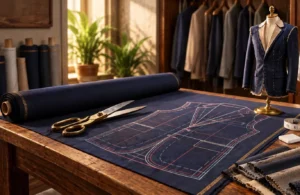
At its core, bespoke tailoring starts with a blank sheet of paper. The tailor takes your measurements, observes how you stand and move, and drafts a paper pattern for your body alone. That pattern is then used to cut the cloth.
The measurements go well beyond chest, waist and sleeve length. A tailor will also note shoulder slope, posture and any asymmetry, such as one shoulder sitting lower than the other. These details are built into the pattern itself rather than corrected afterwards.
Fittings then refine the result. Instead of receiving a finished suit and hoping it sits well, you try the garment at earlier stages, and the tailor adjusts it before final construction. Your preferences on style, cloth and finishing details are worked in along the way.
This is why the individual pattern is treated as the defining feature. Cloth, canvas and hand finishing all matter, but the pattern is where personal fit begins.
What Makes a Suit Truly Bespoke?
Because the word is used flexibly, it helps to look at what actually happens rather than the label. Traditional bespoke practice usually involves several elements working together.
It begins with an individual pattern, drafted for you rather than adapted from a standard block. Alongside it comes a detailed set of measurements and a posture assessment. Some tailors record twenty or more measurements, sometimes many more, though the exact number varies from one tailor to the next.
Next comes the basted fitting, an early try-on of a loosely assembled garment (more on this below). The tailor uses it to judge balance and shape, then adjusts the pattern and the cloth. Depending on the tailor and the body being fitted, further fitting stages may follow. Two or three is common, sometimes more, but no single number defines bespoke.
Throughout, you make choices about styling and construction, from lapel width and pockets to lining and buttons, within what the tailor offers. The process ends with finishing, pressing and a final fitting to confirm the result.
Not every tailor follows identical steps, and some businesses use the word for services that include only a few of them. The specifics matter more than the term.
Bespoke vs Made-to-Measure vs Ready-to-Wear
Three approaches come up most often when people compare options. The table shows how they generally differ. Individual businesses vary, so treat it as a guide rather than a rulebook.
Approach | Pattern | Fittings | Personalisation | Typical Process |
Ready-to-wear | Standard size blocks | None during production; alterations after purchase | Minimal: size, colour and minor alterations | Garment is made before you buy; you choose the closest size and have it altered |
Made-to-measure | Existing base pattern adjusted to your measurements | Usually fewer than bespoke; often one, sometimes none | Moderate, within set options | Key measurements taken, base pattern modified, garment made |
Bespoke | Individual pattern developed for you | Several stages, often including a basted fitting | High | Measurements and posture, pattern drafting, basted fitting, adjustments, further fittings, finishing |
Each has a place. Ready-to-wear is immediate and usually the most affordable, and with sensible alterations it suits many bodies well. Made-to-measure gives a closer fit and more choice in less time than bespoke. Bespoke offers more scope to fine-tune fit and detail, particularly for frames that are asymmetrical or hard to fit, but it usually asks for more time, more appointments and a larger budget. None is universally better; it depends on your body, your timeline and your priorities. Our comparison of bespoke, made-to-measure and ready-to-wear suits in Dubai goes into more detail.
You will also see “made-to-order” and “custom.” These terms are not used consistently. Some businesses use made-to-order for a garment produced from existing sizes after you place the order, while others use it interchangeably with made-to-measure. “Custom” is broader still. Asking how the pattern is created tells you more than the label does.
How Does the Bespoke Tailoring Process Work?
Every tailor works slightly differently, but this reflects the traditional sequence.
1. Consultation and Style Discussion
The conversation starts with the occasion, your preferred style, how you like a suit to fit, colour preferences and practical needs, such as how often you will wear it or whether you travel with it.
2. Fabric Selection
Cloth is chosen based on use, climate, appearance and comfort. The tailor will usually show you fabric books and advise on weight and weave. We cover this in a separate fabric guide, so we will keep it brief here.
3. Measurements and Posture Assessment
This goes beyond the basics. The tailor considers posture, shoulder balance, body shape and how you naturally stand, because two men with identical chest and waist measurements can need very different jackets.
4. Individual Pattern Development
This is the heart of the process. The tailor drafts a pattern on paper from your measurements and observations, shaping it around your posture, your shoulder line and the way your body carries a jacket. Nothing is simply scaled up or down from a standard size.
Because the pattern belongs to you, it can be adjusted as the commission progresses and, in many cases, kept for future garments. That is a practical advantage: a second suit can start from a pattern that has already been refined rather than from scratch.
5. Basted Fitting
The first try-on takes place before the suit is finished, so the tailor can judge fit while changes are still easy to make. The next section explains it in more detail.
6. Pattern Adjustments and Construction
Observations from the fitting are marked on the garment and transferred back to the pattern. The suit is then built up further, with canvas work, lapels and structural details added.
7. Further Fitting and Finishing
One or more later fittings refine the waist, sleeves, trouser line and overall drape. Final pressing, buttons and finishing follow, and a last try-on at delivery confirms everything sits as intended. The number of stages varies between tailors and between customers.
What Is a Basted Fitting?
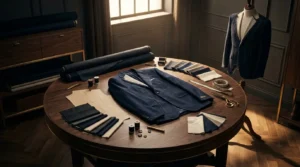
A basted fitting is the first try-on of your suit in an unfinished state. The pieces have been cut from your pattern and loosely held together with temporary stitches, called basting. There is typically no lining, and sometimes only one sleeve is attached.
It looks rough, but that is the point. Temporary stitching can be opened, moved and re-pinned in minutes, whereas a finished garment cannot be reshaped in the same way.
At this stage the tailor can assess balance (whether the jacket hangs evenly front and back), shoulder fit, chest room, length and how the cloth behaves on your frame. Adjustments are marked directly on the fabric. Those marks are later transferred to the paper pattern, so what the tailor learns during the fitting improves both this suit and any future ones.
Made-to-measure services generally do not include this stage, which is one of the clearer differences between the two approaches.
Bespoke Suit Construction: Fused, Half Canvas and Full Canvas
Construction describes what sits inside the jacket, between the outer cloth and the lining. It affects shape, drape and how the jacket ages.
Fused construction bonds an interlining to the outer cloth using heat-activated adhesive. It is quicker and less expensive, though it can feel stiffer and may bubble over time.
Half canvas places a floating canvas layer through the chest and lapel, while the lower part of the jacket is fused. It offers better shape than fully fused construction at a lower cost than full canvas.
Full canvas runs a stitched, unglued canvas layer through the whole front of the jacket. It allows the cloth and canvas to move independently, which many tailors value for drape and longevity.
Here is the point that often gets muddled. “Full canvas” describes the internal construction of a jacket. “Bespoke” describes the pattern-making and fitting approach. They are separate things, so full canvas does not automatically mean bespoke, and bespoke does not automatically mean full canvas. A jacket built on a base pattern can have full canvas, while a bespoke jacket can be built in different ways depending on the tailor and the garment.
Construction is worth asking about, but it is not proof of bespoke on its own. Our guide to full canvas vs half canvas suits explains the practical differences.
Bespoke Tailoring in Dubai: What Should You Consider?
Dubai adds a few practical questions that a London-based guide would not raise. Summers are hot and humid, yet offices, malls and event venues are often strongly air-conditioned. A suit may spend a day moving between both extremes, so fabric weight and construction deserve real thought.
For hot weather and outdoor occasions, lightweight options such as high-twist wool (often called fresco), tropical wool, linen and light cotton are commonly recommended for breathability. For business wear, midweight worsted wool or fresco works for many people who commute in the heat. Weddings and evening events are different again: wool-silk and wool-mohair blends are often suggested for their drape and formality in air-conditioned venues. If you travel often, lightweight worsteds and fresco tend to handle different climates well. Heavy tweeds and thick flannels are usually a poor fit for regular summer wear.
It is also worth asking your tailor about lining and construction. A lighter build, such as a partially lined jacket, can improve comfort in warm weather, though the right choice depends on the cloth and the look you want.
Timing matters too. Bespoke usually takes several weeks to a few months, depending on the tailor and the number of fittings. For a wedding, starting three to four months ahead is sensible. If you are visiting Dubai briefly, ask whether a compressed schedule is possible and what it would mean for the process, since fewer fittings can limit how much refinement is possible.
For more, see our suit fabric glossary and our guide to the best suit fabrics for Dubai weather.
How Much Does Bespoke Tailoring Cost?
There is no single price, and any figure quoted without context should be treated carefully. Cost varies with the fabric, the construction, the amount of pattern and fitting work, how much is finished by hand, the number of fittings, the type of garment, the tailoring service itself and the level of personalisation.
Bespoke generally costs more than ready-to-wear or made-to-measure because it involves more skilled time. But price alone does not tell you how a suit was made. If you want detailed figures, our guide to how much a bespoke suit costs in Dubai covers it properly.
How Can You Tell If a Suit Is Actually Bespoke?
Terminology varies, so asking specific process questions is more useful than relying on the label alone. None of these questions implies anything negative about a tailor; a good one will be glad to answer them.
- Is an individual pattern created for me? If the answer is that a standard pattern is adjusted, the service is closer to made-to-measure.
- Will I have a basted fitting? This tells you whether the garment can be reshaped before it is finished.
- How many fitting stages are expected? There is no universal number, but the answer shows how the process is structured.
- How are fitting changes transferred to the pattern? This shows whether the pattern is actively refined.
- Who cuts and fits the garment? It helps to know whether the person drafting your pattern is also the one at your fittings.
- What type of canvas construction is used? Fused, half canvas and full canvas each have different characteristics.
- Which parts are hand-finished and which are machine-made? Most tailors use both, and a clear answer is a good sign.
If you would like more guidance on judging a tailor’s work, our articles on how to spot a good tailor and how to choose the best tailor in Dubai may help.
Common Misconceptions About Bespoke Tailoring
“Bespoke means everything is hand-sewn.” Bespoke usually involves a lot of handwork, but machines are commonly used for long structural seams. The defining features are the individual pattern and the fitting process.
“Full canvas automatically means bespoke.” It does not. Canvas is an internal construction choice, and a jacket can have it without an individually drafted pattern.
“A higher Super number always means better fabric.” Super numbers indicate how fine the wool fibres are, not how durable or suitable the cloth is. Very high numbers feel softer but can be more delicate.
“Custom and bespoke always mean the same thing.” Not necessarily. “Custom” is often used loosely and may describe made-to-measure or other services.
“More fittings automatically mean a better suit.” The quality of each fitting and the skill of the cutter matter more than the count. A straightforward frame may need fewer stages than a complicated one.
“A high price proves a suit is bespoke.” A high price can reflect fabric, brand or location. It says little about how the pattern was made.
Frequently Asked Questions
What does bespoke tailoring mean?
It means making a garment around one customer, using an individually developed pattern and a fitting process that refines the garment before it is finished. It means making a garment around one customer, using an individually developed pattern and a fitting process that refines the garment before it is finished.
What is the difference between bespoke and made-to-measure?
Made-to-measure usually adjusts an existing base pattern to your measurements, generally with fewer fitting stages. Bespoke develops a pattern specifically for you and usually involves more fitting.
Is a bespoke suit made from scratch?
The pattern is, yes. It is drafted around your measurements and posture rather than adapted from a standard size, and it is then used to cut the cloth.
What is a basted fitting?
It is an early try-on of a loosely stitched, unfinished garment, allowing the tailor to assess balance and fit and make changes before final construction.
Is full canvas the same as bespoke?
No. Full canvas describes the jacket’s internal construction, while bespoke describes the pattern and fitting approach. One does not guarantee the other.
How long does a bespoke suit take?
It varies by tailor, cloth and number of fittings, but expect several weeks to a few months. For a wedding, allow three to four months if you can.
Is bespoke tailoring suitable for Dubai's climate?
It can be, because fabric, weight and construction are chosen for your needs. Lightweight cloths and lighter builds are commonly used for hot weather.
Is bespoke tailoring worth considering for a business or wedding suit?
It depends on your priorities. It suits people who want detailed control over fit and style and can invest the time. Made-to-measure or well-altered ready-to-wear can also work well.
Final Takeaway
The idea behind bespoke tailoring is simple: a pattern developed for one person and refined through fitting. That is what sets it apart, not an expensive fabric, full canvas construction or the word “bespoke” on a price tag.
It is not automatically the right choice for everyone. Made-to-measure and ready-to-wear each have real strengths, and the best option depends on your body, your schedule and how much involvement you want. Whichever route you take, ask clear questions about how the suit will be made and choose the service that matches what you need.

Daniel Carter
British, Dubai-based, and I've been around cloth most of my life. My grandfather had a small alterations shop in Leeds. I spent Saturdays there as a teenager, learning the difference between a canvassed chest and a fused one years before I understood why anyone should care.
I write about tailoring from the position of someone who's been fitted, let down, and fitted again. Drape, balance, sleeve pitch, the weight of a proper 13oz worsted. I'm not especially interested in brand names, mostly because they tend to get credit that belongs to the cut.
The UAE is still fairly new to me. Two years in and I'm working through the tailoring houses here, figuring out who cuts well and who just cuts fast. I'd rather take notes than hand out verdicts I haven't earned yet, so treat this as a map that's still being drawn.
Outside of clothes, I eat well and I eat curiously — the odder the menu, the more likely I am to book it. Whisky too, unhurried. Islay when the weather cooperates, Speyside when it doesn't.
Most of what I like takes time to make. That's more or less the whole thesis.
Last Updated:September 25, 2026
Categories
Recent Articles